Why rice, soup, and several small dishes have long been a familiar combination in Japanese food.
When people think of Japanese food, sushi, ramen, and tempura often come to mind.
But everyday meals in Japan can look much simpler.
Rice, miso soup, some fish or meat, and a few vegetables—this familiar style of meal can be understood through a traditional Japanese expression:
ichiju sansai (一汁三菜).
Literally, it means “one soup, three dishes.”
But there is something important that the name does not tell you. Rice and tsukemono are also traditionally part of the meal, but neither is included in the count.
Tsukemono are often translated as “Japanese pickles,” but they are more varied than the cucumber pickles common in the United States. They can be made from daikon radish, cucumber, eggplant, Chinese cabbage, and other vegetables, and preserved in different ways using salt, rice bran, vinegar, miso, and more.
Rice is the staple of the meal, while tsukemono is usually served in a small amount alongside it.
So the “one” and “three” in ichiju sansai refer only to the soup and dishes.
What Makes Up Ichiju Sansai?
The basic arrangement looks like this:
- Rice — the staple
- One soup — often miso soup
- One main dish
- Two side dishes
- Tsukemono — served alongside the meal
Ichiju (一汁) means “one soup,” while sansai (三菜) means “three dishes.”
The three dishes generally consist of one main dish and two smaller side dishes.
The main dish might be fish, meat, tofu, eggs, or another substantial food. Side dishes often contain vegetables, seaweed, mushrooms, beans, or other ingredients.
Rice has a different role. It is not one of the three dishes. It is the staple around which the meal is organized.
Why Is Rice at the Center?
Plain Japanese rice is usually served without much seasoning of its own.
Instead, much of the flavor comes from what is eaten with it.
Fish may be grilled with salt or simmered in soy sauce. Vegetables can be seasoned with soy sauce, miso, sesame, or other ingredients. Miso soup and tsukemono add still more flavors.
These foods are eaten together with relatively plain rice.
This also helps explain how a traditional Japanese meal is often eaten.
You might take a bite of rice, then some fish, go back to the rice, eat some vegetables, take a sip of soup, and continue that way.
The dishes are separate, but they work together as one meal.
Does It Really Have to Be One Soup and Three Dishes?
No.
The term ichiju sansai can make the structure sound more rigid than it actually is.
There is also ichiju issai (一汁一菜)—one soup and one dish—and ichiju nisai (一汁二菜)—one soup and two dishes.
Everyday home cooking is even more flexible.
Sometimes there are fewer dishes. Sometimes there is no soup. Vegetables may be served on the same plate as the main dish.
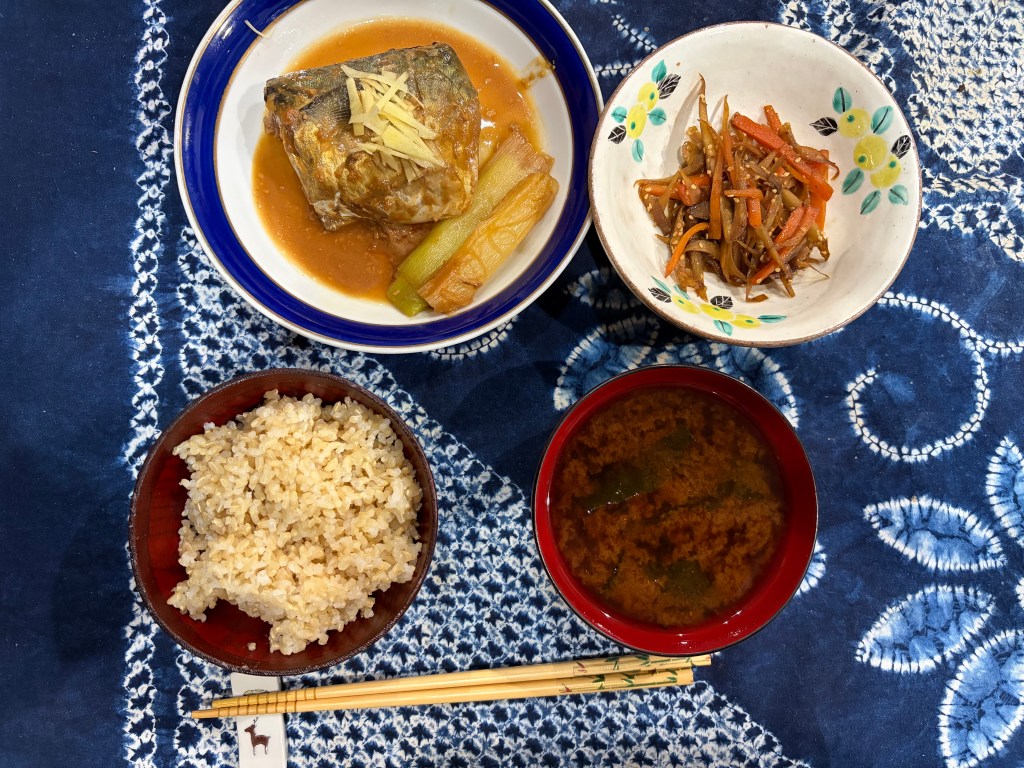
An everyday home-cooked meal with rice, miso soup, simmered fish, and a vegetable side dish.
This meal, for example, is closer to ichiju nisai: one soup and two dishes.
It does not have three separate dishes, but the familiar combination of rice, soup, a main dish, and vegetables is still there.
Modern Japanese Home Cooking Is Much Broader
Japanese home cooking today also includes many foods that did not originate in traditional Japanese cuisine.
One familiar example is hambāgu (ハンバーグ), Japanese-style hamburger steak.
It has Western roots, but it has been adapted in Japan and has become a very ordinary home-cooked dish.
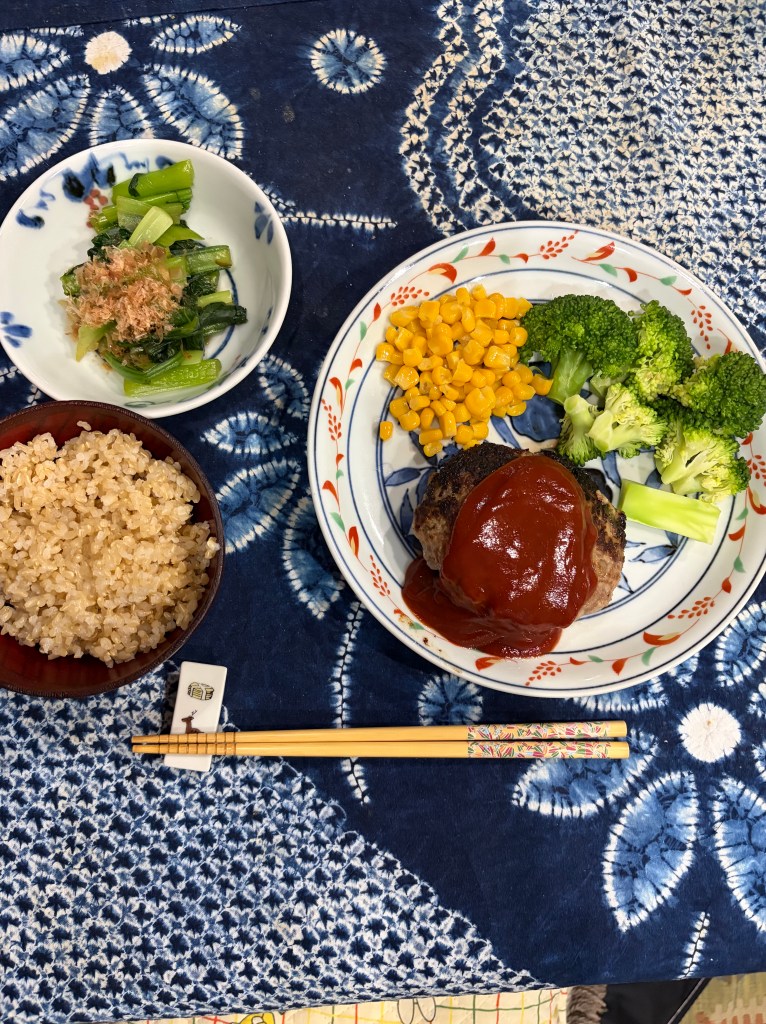
A home-cooked meal with rice, hamburger steak, vegetables, and greens.
There is no soup here, so this is not ichiju sansai.
And that is perfectly normal.
A household might have grilled fish, rice, and miso soup one night, curry rice another night, and hambāgu the next.
Japanese people do not necessarily plan every meal by counting one soup and three dishes.
Ichiju sansai is better understood as a traditional framework rather than a rule that every meal must follow.
What About Nutrition?
Ichiju sansai is often associated with a balanced diet, and it is easy to understand why.
Rice provides carbohydrates. A main dish may provide protein from fish, meat, eggs, or tofu. Smaller dishes make it easier to include vegetables, mushrooms, seaweed, beans, and other ingredients.
Miso soup can also contain tofu, vegetables, seaweed, mushrooms, shellfish, and many other foods.
Having several dishes therefore makes it easier to include a variety of ingredients in one meal.
But ichiju sansai does not automatically make a meal healthy. Ingredients, portions, seasoning, and cooking methods still matter.
It makes more sense to think of it first as a way of organizing a meal.
You Can Still See the Pattern Today
Not every meal in modern Japan follows ichiju sansai.
Breakfast might be toast and coffee. Lunch could be ramen. Dinner might be pasta, curry, a rice bowl, or something bought at a convenience store.
But the traditional pattern has not disappeared.
One of the easiest places to notice it is in a teishoku (定食), or Japanese set meal.
Order a teishoku in Japan and you will often receive rice, soup, a main dish, and one or more smaller dishes.
It may not be exactly ichiju sansai, but once you know the basic idea, the arrangement becomes easier to understand.
So ichiju sansai is not a rule for what Japanese people eat every day. It is a traditional pattern that still helps explain the structure of many Japanese meals today.


コメントをどうぞ