How an intentionally soft rice cracker became a local specialty in one of Japan’s great soy sauce towns.
When most people think of Japanese rice crackers, or senbei, they imagine something crisp and crunchy.
But in the seaside city of Choshi, on the eastern edge of Chiba Prefecture, there is a very different kind of rice cracker.
It is soft. It is moist. And that is exactly how it is supposed to be.
This is nure senbei—literally, “wet rice cracker.”
At first, the name may not sound particularly appetizing in English. A “wet cracker” might even sound like a cracker that has simply gone stale.
But nure senbei is something quite different.
Its soft texture is intentional, created by allowing a savory sauce to soak into the freshly baked rice cracker.
And to understand why this unusual snack feels so at home in Choshi, it helps to know something about the city itself.
A Seaside Town Shaped by Soy Sauce
Choshi sits where the Tone River meets the Pacific Ocean.
It is well known as a fishing town, but Choshi also has a long history of soy sauce production.
That combination—rice crackers and deeply flavored seasonings—helps make nure senbei feel particularly connected to the local food culture.
Unlike an ordinary senbei, which is valued for its crispness, nure senbei absorbs its seasoning while retaining a soft, slightly chewy texture.
So the softness is not a flaw.
The texture is the point.
It is a small example of something that makes exploring regional Japanese food so interesting: even something as familiar as a rice cracker can change dramatically from one place to another.
A Souvenir I Found in Choshi
I recently visited Choshi for work and brought home some local rice crackers made by Ishigami.
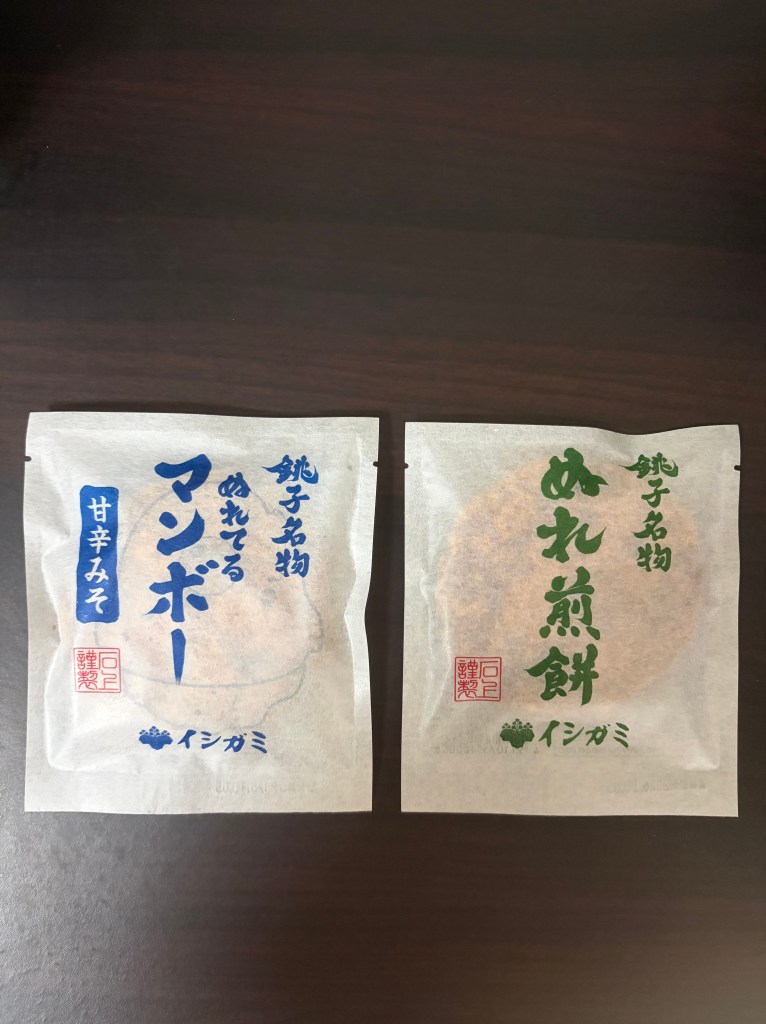
Some of the rice crackers I brought home from Choshi.
One of the products was nure senbei, but another immediately caught my attention because of its unusual name and appearance:
Nureteru Manbo.
“Manbo” means ocean sunfish in Japanese.
The cracker has a seaside character that fits Choshi particularly well, combining the shape of an ocean sunfish with green seaweed and a sweet-savory miso flavor.
It is a playful snack, but it also reflects its place of origin—the sea, Japanese seasonings, and the local tradition of rice crackers all come together in one product.
Nure Senbei as an Omiyage
Rice crackers like these are also commonly sold as omiyage, or local gifts.
In Japan, people often bring back food from a trip for family members, friends, or coworkers. This is one reason regional snacks are frequently sold in boxes with individually wrapped pieces—they are easy to take home and share.
Choshi has many foods associated with the area, and nure senbei is one of the snacks visitors may encounter there.
For someone unfamiliar with it, the texture is probably the most surprising part. Ordinary senbei is usually crisp, while nure senbei is deliberately soft because the seasoning has soaked into the cracker.
I bought some during my visit to Choshi, and that contrast was what I found most interesting.
If you come across nure senbei in Japan, the important thing to know is that it has not simply gone soft. That is how it is meant to be eaten.
Its combination of rice cracker, soy-based seasoning, and soft texture makes it a rather unusual example of Japan’s regional snack culture.
Planning a Visit to Choshi?
If you’d like to explore Choshi and its local food culture for yourself, the Choshi Tourism Association provides information on sightseeing, local food, transportation, and places to visit.
→ Choshi Tourism Association (Japanese)
The rice crackers featured in this article were made by Ishigami, a local rice cracker company in Choshi.
→ Ishigami on the Choshi Tourism Association website (Japanese)


コメントをどうぞ